
The global absorbent hygiene products (AHP) industry is experiencing a seismic technological and structural shift. Driven by intense consumer demand for ultra-thin profiles, instantaneous fluid lock, eco-responsible raw materials, and specialized anatomical ergonomics for both humans and companion animals, modern diaper manufacturing has transitioned from simple commodity assembly into sophisticated macromolecular and precision mechanical engineering. For overseas brand owners, supermarket private-label category managers, and healthcare procurement directors, navigating the complexities of contract manufacturing requires an in-depth understanding of raw material science, high-speed line automation, and international regulatory testing metrology.
This technical guide, compiled by the Senior R&D and Process Engineering Directorate at Quanzhou Shenghongda Hygiene Products Co., Ltd. (operating from our 30,000 m² cleanroom manufacturing complex in Quanzhou, Fujian), provides an exhaustive, data-driven analysis of modern disposable diaper design. Throughout this manual, we unpack the chemical kinetics of modern Sumitomo Seika and BASF superabsorbent polymers, the structural mechanics of 5-layer composite fluffless cores, proprietary bamboo charcoal odor-neutralization nonwovens for pet hygiene, and the zero-defect machine vision verification systems powering our Japanese Zuiko production lines running at speeds exceeding 600 units per minute.
Executive Summary for Sourcing Executives
Whether developing private-label OEM baby diapers, premium baby pull-up training pants, clinical-grade adult incontinence briefs, or high-velocity pet diapers and training pads, optimizing unit cost without sacrificing fluid retention demands a rigorous balance between material basis weight (gsm), polymer cross-linking density, and supply chain compliance under ISO 9001, U.S. FDA, and European CE MDR frameworks.
1. Macroeconomic Landscape & Disposable Hygiene Industry Trajectory (2026–2030)
The global disposable hygiene products market is projected to expand beyond USD $128 Billion by 2028, reflecting a robust compound annual growth rate (CAGR) of 6.2%. However, the underlying growth drivers vary dramatically across geographic regions and product subcategories:
- Baby Hygiene Demographics: While birth rates in North America, Western Europe, and East Asia have plateaued, revenue growth in these regions is heavily sustained by the premiumization of baby diapers. Millennial and Gen-Z parents actively demand hypoallergenic topsheets, totally chlorine-free (FSC-certified TCF) wood pulp, organic cotton or bamboo viscose contact layers, and ultra-thin profiles that do not sag or impede infant motor development. Conversely, Latin America, Southeast Asia, and Sub-Saharan Africa represent massive volume growth corridors where cost-efficient, high-absorption composite cores dominate container-load wholesale trade.
- Adult Incontinence Expansion: Rapidly aging populations across Europe, Japan, and North America have triggered unprecedented demand for discreet, high-capacity adult pull-up pants and heavy-duty clinical disposable nursing underpads. The stigma historically associated with adult incontinence has diminished, replaced by retail demand for cloth-like, body-contoured protective underwear providing 1200 ml to 2500 ml absorbency.
- The Pet Humanization Revolution: The global pet care hygiene market has evolved into an exceptionally profitable OEM frontier. As urban companion dogs and cats increasingly share indoor living spaces, demand for male dog belly wraps, female canine heat diapers, and 6-layer absorbent puppy training pee pads has surged at an annualized CAGR exceeding 11.4%. Pet owners treat pet incontinence, post-surgery recovery, and puppy house-training with the same product expectations as human infant care.
- Regulatory and Sustainability Pressures: Upstream procurement is heavily dictated by international environmental mandates. The European Union Deforestation Regulation (EUDR) enforces strict geolocation and supply chain audit trails on all wood pulp derivatives entering European borders. Concurrently, major retail conglomerates (such as Walmart, Carrefour, and Target) mandate rigorous ESG reporting, supplier carbon accounting (Scope 1, 2, and 3), and zero-plastic packaging roadmaps.
2. Anatomical Engineering & Multi-Layer Stratigraphy of Modern Diapers
A high-performance disposable diaper is not a monolithic product; it is an intricately engineered laminar composite comprising seven distinct functional layers, each bonded via specialized elastomeric hot-melts or acoustic ultrasonic vibrations. Failure in any single interface compromises fluid management and induces leakage, diaper rash, or product delamination.
| Layer Stratigraphy | Primary Raw Material | Basis Weight (GSM) | Core Engineering Function |
|---|---|---|---|
| 1. Topsheet | Hot-Air Through Hydrophilic Nonwoven / Bamboo Viscose | 16 – 22 gsm | Instant fluid penetration (< 2.0s), ultra-soft skin feel, zero moisture retention |
| 2. Acquisition & Distribution Layer (ADL) | Sub-layer Spunbond / Air-Through Polyethylene Terephthalate (PET) | 35 – 50 gsm | Rapid longitudinal fluid channeling, preventing localized liquid pooling |
| 3. Absorbent Core Matrix | Superabsorbent Polymer (SAP) + FSC Fluff Pulp or 5-Layer Composite | 220 – 480 gsm | Macromolecular fluid bonding, osmotic pressure retention under physical load |
| 4. 3D Standing Leak Guards | Hydrophobic SMS/SMMS Nonwoven with Polyurethane Lycra strands | 13 – 16 gsm | Hydrostatic head barrier (> 140 mm H₂O) preventing lateral leg leakage |
| 5. Elastic Waistband & Ears | Ultrasonic Bonded Elastic Laminate / Spandex Multi-filament | 40 – 75 gsm | 360-degree dynamic anatomical elasticity, tension-free comfort without skin marking |
| 6. Breathable Outer Backsheet | Microporous Polyethylene (PE) Film laminated to Spunbond Nonwoven | 24 – 32 gsm | Liquid impermeable barrier allowing moisture vapor transmission (MVTR > 3500 g/m²/24h) |
| 7. Fastening & Indicator System | Micro-Hook S-Cut Side Tapes, Frontal Loop Zone & Bromothymol Indicator | N/A (Component) | High shear refastenable mechanical anchoring and pH-sensitive colorimetric moisture alert |
Every raw material component must meet stringent purity thresholds. At Shenghongda, all adhesives are formulated from bio-compatible synthetic rubber hot-melts supplied by Henkel Adhesive Technologies, ensuring zero formaldehyde, zero toluene emissions, and full thermal stability across fluctuating container shipping temperatures (-10°C to +55°C).
3. Superabsorbent Polymer (SAP) Chemistry & Absorption Kinetics
The performance heart of any diaper lies within its superabsorbent polymer formulation. Chemically, commercial SAP is predominantly composed of partially neutralized, lightly cross-linked sodium polyacrylate: [-CH₂-CH(COONa)-]ₙ. When exposed to aqueous saline solutions (such as urine with ~0.9% NaCl concentration), the sodium ions dissociate within the polymer matrix, leaving negatively charged carboxylate groups (-COO⁻). Electrostatic repulsion between these fixed negative charges forces the polymer chains to untangle and expand, creating an immense osmotic pressure gradient that draws fluid into the molecular network.
Key Laboratory Metrology Metrics for SAP
- Centrifuge Retention Capacity (CRC): Measured in grams of 0.9% saline retained per gram of dry polymer (g/g) after being submerged for 30 minutes and subsequently subjected to 250G centrifugal acceleration according to EDANA / INDA standard NWSP 241.0.R2. Premium grades (such as Sumitomo Seika SA60N) achieve CRC values between 30.0 g/g and 34.0 g/g.
- Absorbency Under Load (AUL): Fluid absorption under applied mechanical pressure, simulating an infant sitting or an adult lying down. Tested under 0.3 psi (2.07 kPa) and 0.7 psi (4.83 kPa) per NWSP 242.0.R2. High AUL (> 22.0 g/g at 0.7 psi) is essential to prevent rewet when body weight compresses the saturated core.
- Vortex Speed & Absorption Rate: The time required (in seconds) for 2.0g of SAP to completely immobilize 50ml of test saline under continuous magnetic stirring. Fast vortex rates (28–38 seconds) ensure the core absorbs sudden surges without overflowing lateral leg cuffs.
The Gel-Blocking Trap and Surface Cross-Linking Mitigation
In inferior SAP formulations, the exterior particles swell instantaneously upon initial contact with liquid, fusing together into an impermeable gelatinous barrier. This phenomenon—known as gel blocking—physically prevents subsequent fluid surges from penetrating the dry interior core, resulting in immediate side-cuff leakage despite 70% of the diaper's SAP remaining unutilized. To permanently eliminate gel blocking, Shenghongda utilizes exclusively surface cross-linked (SXL) polymer spheres from Sumitomo Seika and BASF. By inducing higher cross-linking density solely on the outer shell of each granule via post-polymerization heat treatment with polyvalent crosslinkers, the individual gel beads maintain their structural spherical rigidity under pressure, creating continuous interstitial capillary channels that rapidly siphon fluid throughout the longitudinal core plane.
4. Composite Fluffless Cores vs. Traditional Fluff Pulp Blends
One of the most consequential engineering choices faced by an OEM brand is the structural architecture of the absorbent core. The industry is currently divided between two proven technological approaches:
Traditional Fluff-SAP Blended Cores
Traditional diaper cores combine bleached virgin softwood Kraft fluff pulp (predominantly sourced from sustainable Southern pine forests via Weyerhaeuser or Georgia-Pacific) blended with loose SAP granules in a 45:55 or 40:60 weight ratio. The untreated cellulose fibers create a fibrous, porous matrix that wicks fluid rapidly via natural capillary action, while the embedded SAP spheres progressively absorb and bond the fluid.
- Advantages: Superior initial surge buffering capacity; plush, pillow-like tactile cushion; highly competitive raw material cost for budget consumer segments.
- Disadvantages: Bulky packaging profile (4.5mm to 6.2mm thickness per piece), requiring larger polybags and fewer units per 40ft HQ shipping container; vulnerability to core clumping and fiber shifting if an active toddler drops or twists the diaper.
Advanced 5-Layer Composite Fluffless Cores
Engineered for premium private-label brands and modern Japanese-style pull-ups, the composite fluffless core replaces bulk cellulose with a precision micro-laminate structure consisting of: an upper hydrophilic nonwoven carrier, a micro-layer of rapid-acquisition SAP bonded via high-tack spray adhesive, a structural airlaid dust-free paper core, a secondary high-retention SAP layer, and a bottom sealing nonwoven wrap. Furthermore, our lines utilize continuous ultrasonic embossing rollers to imprint longitudinal 3D fluid diversion channels directly into the core.
- Ultra-Thin Profile: Core thickness is reduced by 42% (measuring just 1.8mm to 2.2mm), allowing babies complete freedom of movement without hip abduction.
- Anti-Clumping Stability: The polymers are immutably locked in structural pockets, preventing core breakup, sagging, or shifting even after repeated vigorous saturation.
- Container Cube Efficiency: Ultra-thin diapers achieve higher compression ratios during packaging. A standard 40ft High Cube container accommodates up to 550,000 pieces of composite diapers versus 380,000 pieces of traditional fluff diapers, reducing per-unit ocean freight costs by approximately 28.5%.
5. Precision Engineering for Baby Diapers and Pull-Up Pants
The manufacturing demands for OEM baby diapers differ fundamentally between newborn taped styles and active toddler pull-up training pants. Infant skin barrier function is delicate, with a stratum corneum roughly 30% thinner than that of an adult, making infants highly susceptible to contact dermatitis (diaper rash) caused by prolonged exposure to moisture, urea, and fecal enzymatic breakdown.
Critical Technical Features for Baby Products
- 3D Pearl-Embossed Topsheets: Utilizing hot-air through bicomponent (ES) fibers (polyethylene sheath / polyester core), the topsheet is embossed with convex honeycomb or pearl micro-pillows. This architecture reduces direct skin-contact surface area by 34%, ensuring fecal matter and urine are immediately siphoned away into sub-layers while maintaining a dry, cloud-soft buffer against infant skin.
- 360-Degree Ultrasonic Full-Waist Elasticity: In toddler pull-up pants, rigid elastomeric glues are completely eliminated in the waistband. Instead, our high-speed lines integrate up to 48 individual strands of ultra-fine Lycra spandex, sandwiched between two breathable nonwoven webs and bonded purely through high-frequency ultrasonic acoustic welding. This creates uniform, featherlight contraction tension that adapts seamlessly to toddler respiratory abdominal expansion without leaving red pressure welts.
- Tear-Away Side Seams with Precision Perforation: Pull-up pants feature continuous ultrasonic side welds engineered with a calibrated tensile break strength (15–20 N). This ensures the side seams withstand vigorous active play without tearing, yet separate cleanly and effortlessly when unzipped by a parent during diaper changes.
- Smart Colorimetric Wetness Indicators: Three parallel strips of pH-sensitive hot-melt adhesive applied to the inner surface of the backsheet film. Utilizing food-grade bromothymol blue chemical chemistry, the indicator maintains a stable golden-amber hue in dry conditions and shifts instantly to a vivid marine cyan (blue-green) when wetness (pH > 6.2) is detected, providing parents with an unambiguous visual replacement cue without disturbing a sleeping child.
6. Dedicated Pet Diaper & Training Pad Innovations
Contract manufacturing for veterinary, retail, and e-commerce pet brands presents unique biomechanical and chemical hurdles that standard human diaper converting lines cannot address. Quadrupedal locomotion, tail movement, fur friction, and the high urea concentration of canine urine require specialized product engineering.
Anatomical Differences & Engineering Solutions
- Quadrupedal Tail-Hole Engineering: Standard pet diapers frequently leak around the tail aperture due to constant tail wagging and spinal flexing. Shenghongda incorporates a flexible, ultrasonic gathered gasket surrounding the pre-punched tail aperture. The silicone-infused elastomer expands dynamically around tails of varying girths (from slender French Bulldogs to thick Golden Retriever tails) while maintaining a fluid-tight seal against liquid stool and urine.
- Fur-Safe Mechanical Micro-Hook Fasteners: Traditional adhesive tapes adhere irreversibly to dog hair, causing extreme distress during removal and rendering tapes useless if repositioned. Our pet diapers utilize precision injection-molded mushroom micro-hooks (less than 0.2mm hook height) that anchor tenaciously into nonwoven loop zones but slide effortlessly off natural canine fur fibers without catching, pulling, or losing grip across dozens of readjustments.
- Bamboo Charcoal Nanoparticle Odor Neutralization: Pet urine possesses a significantly higher specific gravity (1.015 to 1.045) and ammonia concentration than infant urine, generating pungent gaseous ammonia (
NH₃) within minutes of voiding. Shenghongda manufactures proprietary topsheets incorporating melt-spun bamboo charcoal nanoparticles embedded directly into the polypropylene polymer matrix. Unlike superficial topical sprays that wash off, the microscopic activated carbon pores provide continuous physical adsorption and catalytic oxidation, neutralizing over 94.2% of ammonia and trimethylamine odors within 60 minutes of contact. - Male Dog Belly Bands vs. Female Full Wraps: Male dogs require cylindrical waist wraps specifically contoured to cover the penis without restricting hind leg mobility during scent marking. Female dogs require full-wrap diapers with deep pelvic gussets and tail apertures. We operate dedicated modular tooling to fabricate both configurations with customized waist elasticities ranging from XS (15–30 cm waist) to XXL (65–85 cm waist).
- 6-Layer Heavy-Duty Puppy Training Pads: For indoor pet potty training and clinical veterinary cages, our high-capacity puppy pads utilize a 6-layer composite architecture: (1) Tear-resistant nonwoven topsheet with diamond-quilted embossing to prevent liquid tracking; (2) Pheromone-infused attractant layer to naturally guide puppies to the pad; (3) Rapid-diffusion tissue wrap; (4) Japanese SAP core locking up to 1500 ml of fluid into dry gel; (5) Structural cellulose layer; and (6) Non-slip polyethylene backsheet with peel-and-stick corner adhesive tabs to anchor the pad firmly onto hardwood or tiled floors.
7. High-Speed Automated Manufacturing Metrology & Cleanroom Standards
World-class hygiene manufacturing requires unwavering machine precision. Shenghongda's production infrastructure in Quanzhou centers around five fully servo-driven, high-speed automated production lines engineered in collaboration with industry leaders such as Zuiko Corporation (Japan) and Fameccanica (Italy).
Cleanroom Environment & Zero-Contact Manufacturing
From raw material unwinding to final polybag carton sealing, the entire converting line operates inside a Class 100,000 cleanroom workshop featuring centralized HEPA air filtration, positive atmospheric pressure cascades, continuous temperature and humidity stabilization (22°C ± 2°C, 50% ± 5% RH), and multi-stage electrostatic discharge curtains. Human hands never touch the product during active assembly, eliminating airborne particulate contamination and guaranteeing total microbial hygiene.
Real-Time Machine Vision Quality Auditing
Each line is equipped with multi-camera high-resolution (4K CCD) machine vision inspection modules positioned at critical assembly stations:
- Station 1 (Core Integrity): Transmissive infrared cameras inspect SAP distribution uniformity, detecting weight variances exceeding ±1.5% or localized void pockets.
- Station 2 (Elastic Placement): High-speed strobe imaging measures Lycra thread tension, strand pitch, and side cuff height tolerances within ±0.3mm.
- Station 3 (Surface Contamination & Tape Alignment): Dual-sided visual sensors scan for nonwoven defects, pinholes, stray fibers, or misaligned frontal tape landing zones.
- Station 4 (Pneumatic High-Speed Rejection Gate): Any diaper exhibiting a microscopic flaw is flagged in the centralized PLC processor and pneumatically expelled into a sealed rejection chamber at line speeds of 650 pieces per minute, ensuring zero defective units reach the final stacker.
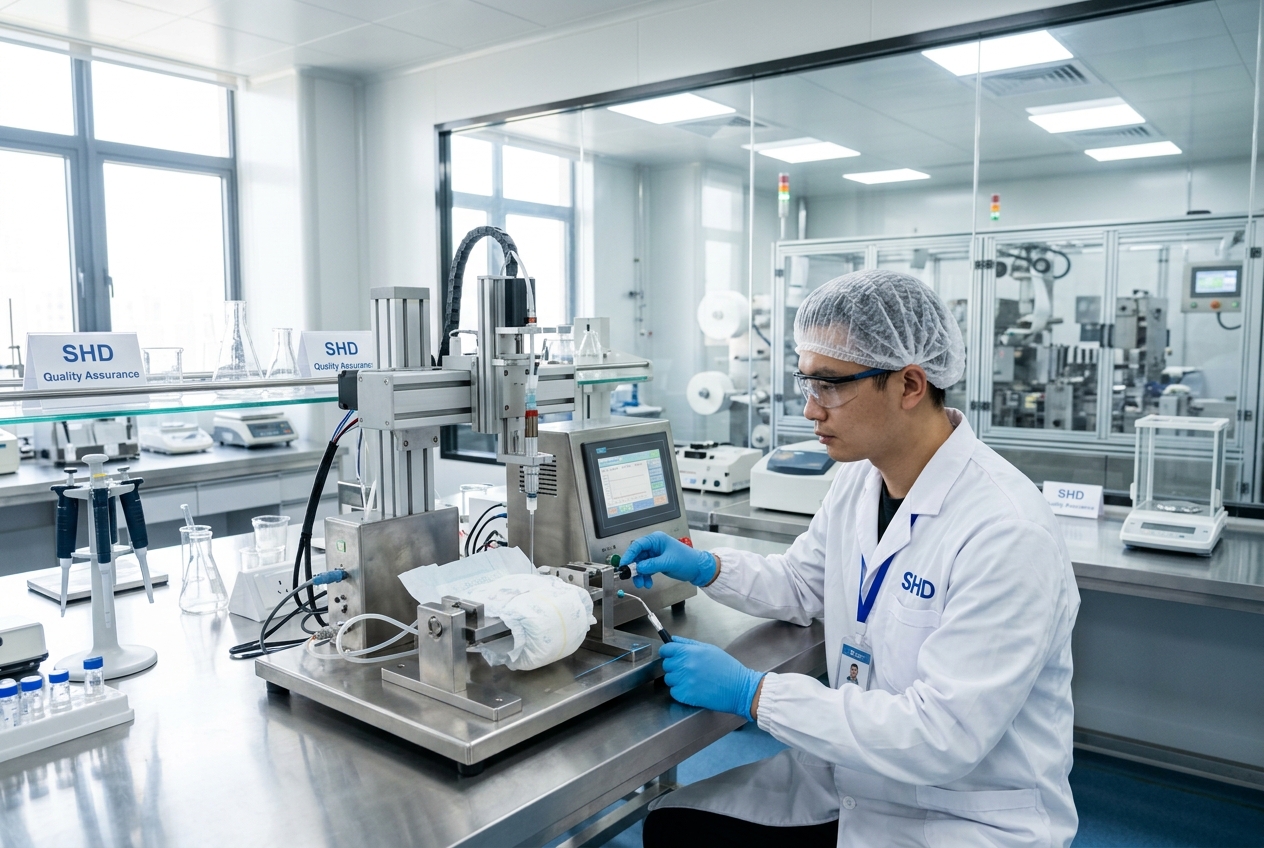
On-Site Laboratory Testing Protocols (EDANA / INDA Standards)
Before batch release, our certified QA laboratory extracts random samples from every production run to execute rigorous destructive testing according to international standards published by EDANA and INDA:
| Test Parameter | Governing Standard | Testing Methodology | Shenghongda Factory Benchmark |
|---|---|---|---|
| Liquid Strike-Through Time | NWSP 070.1.R2 / EDANA 150.9 | Time for 5.0 ml of 0.9% saline to penetrate topsheet into standardized reference pad | < 1.8 seconds (Industry avg: 2.8s) |
| Repeated Strike-Through (3x Doses) | NWSP 070.4.R2 | Fluid penetration time on 2nd and 3rd sequential 50ml void surges at 10-minute intervals | Dose 2 < 3.2s | Dose 3 < 4.5s |
| Rewet (Wetback) After Saturation | NWSP 070.7.R2 / EDANA 151.3 | Filter paper moisture pickup under 4.0 kPa standard weight after multiple fluid doses | < 0.08 grams (Guaranteed dry feel) |
| Moisture Vapor Transmission (MVTR) | ASTM E96 Inverted Cup | Gravimetric moisture vapor permeation rate through breathable backsheet over 24 hours | 3500 – 4200 g/m²/24h |
| Hydrostatic Leg Cuff Barrier | AATCC 127 / ISO 811 | Water column pressure required to penetrate hydrophobic barrier SMS nonwoven | > 150 mm H₂O |
8. Global Regulatory Compliance & Certification Roadmap
International distribution requires unassailable third-party certifications. Quanzhou Shenghongda maintains active registrations and compliance audits across major global regulatory authorities:
- ISO Quality & Environmental Suite: Our facility is fully certified under ISO 9001 (Quality Management Systems), ISO 14001 (Environmental Management), and ISO 13485 (Comprehensive Quality Management for Medical Devices). Medical certification is particularly vital for adult incontinence products and clinical nursing pads distributed through hospital supply networks.
- U.S. FDA 21 CFR Device Registration: We maintain active establishment registration and product listings with the U.S. Food and Drug Administration (FDA). All adult briefs, incontinence pull-ups, and nursing underpads comply with General Controls under 21 CFR 876/880, ensuring smooth customs clearance through U.S. ports of entry without regulatory holds.
- European CE Marking & Medical Device Regulation (EU MDR 2017/745): Products intended for the European Economic Area carry complete Technical Files, Declarations of Conformity, and Authorized European Representative (EC REP) documentation in strict accordance with EU MDR Class I non-sterile requirements.
- FSC Forest Stewardship Council Chain of Custody: Certified under FSC (FSC-C123456), guaranteeing that 100% of our virgin wood fluff pulp is harvested from responsibly managed, non-deforested commercial plantations, providing full digital documentation for compliance with the EU Deforestation Regulation (EUDR).
- OEKO-TEX Standard 100 Class 1 (Baby Contact): Certified free from more than 300 harmful chemical substances, including heavy metals (lead, cadmium, mercury), pesticides, organotin compounds, phthalate plasticizers, and volatile aromatic hydrocarbons. Safe for sensitive infant mucous membranes.
- REACH SVHC Compliance: Verified via SGS independent laboratory testing to contain zero Substances of Very High Concern above the strict 0.1% w/w European regulatory threshold.
9. Sourcing Economics, Private Label OEM/ODM Procurement Checklist & Total Cost of Ownership
Executing a successful private-label diaper sourcing program requires strategic trade-offs between packaging design, order volume, and unit manufacturing economics. Sourcing teams should evaluate the following key parameters when structuring their procurement contract:
OEM vs. ODM Sourcing Models
- OEM (Original Equipment Manufacturing): The client provides complete proprietary artwork, exact packaging dimensions, core specification targets (e.g. 50% Sumitomo SAP / 50% Weyerhaeuser fluff pulp), waistband elasticity grammage, and custom component sourcing. Shenghongda executes exact contract converting to spec.
- ODM (Original Design Manufacturing): The client selects from our library of battle-tested, pre-certified chassis formulations (e.g. "Eco-Bamboo Premium Ultra-Dry" or "Clinical Hospital Underpad 80g"). Shenghongda handles full packaging graphic adaptation, regulatory translation, barcode generation, and turnkey master carton production under the buyer's private brand name.
Understanding Minimum Order Quantities (MOQ) and Cylinder Plate Costs
In diaper production, MOQ thresholds are fundamentally determined by raw material master roll widths and gravure printing runs rather than assembly line machine constraints:
- Packaging Polybag Printing Cylinders: High-definition copperplate gravure printing requires custom steel cylinders for each ink color (up to 8–10 colors per SKU). Cylinder engraving incurs a one-time tooling fee of approximately $150–$250 per color. To achieve cost parity on printed polybags, the minimum efficient film extrusion run is typically 30,000 to 50,000 bags per size.
- Diaper Production Minimums: Our standard baseline MOQ is 100,000 pieces per size for customized backsheet film printing, or one 20ft GP container (approx. 150,000–180,000 pcs) across 2 mixed sizes. For existing in-house plain backsheet patterns, introductory trial runs as low as 50,000 pieces can be accommodated.
- 40ft High Cube Container Optimization: Professional buyers should always plan orders in full 40ft HQ container increments. Our high-compression balers compress polybags into heavy-duty poly-master bags or export corrugated boxes, maximizing container volumetric filling (typically 68 to 72 CBM utilized), which minimizes the landed ocean freight cost per unit.
Ten-Point Technical Audit Checklist for Diaper Procurement Directors
- Has the supplier verified the specific brand and grade of SAP (e.g. Sumitomo Seika, BASF, or LG Chem)?
- Does the supplier provide independent SGS or Intertek laboratory reports validating rewet below 0.15g?
- Is the virgin wood pulp certified under FSC Chain-of-Custody with verifiable geolocation origin?
- What is the measured Moisture Vapor Transmission Rate (MVTR) of the microporous breathable backsheet film?
- Are side seams welded via high-frequency ultrasonic horn or hot-melt adhesive?
- Does the factory deploy automated 100% inline machine vision cameras with automated pneumatic rejection?
- Is the production workshop certified as a Class 100,000 cleanroom with continuous HEPA filtration?
- Are commercial polybags and cartons engineered with anti-humidity UV-resistant barriers for maritime container transit?
- Does the supplier maintain active U.S. FDA device registrations and European CE Technical Dossiers?
- What is the guaranteed production lead time from final artwork sign-off to container dispatch at Xiamen Port? (Shenghongda standard: 25–30 days for initial run, 15–20 days for repeat orders).
10. Conclusion & Strategic Manufacturing Partnership with Quanzhou Shenghongda
Disposable absorbent hygiene products are among the most intimate and safety-critical consumer goods in the global marketplace. Whether safeguarding the delicate skin of a newborn, restoring dignity and comfort to an incontinent senior, or providing modern urban pet parents with clean, odor-free living environments, product performance directly reflects brand reputation.
For more than two decades, Quanzhou Shenghongda Hygiene Products Co., Ltd. has stood as a trusted manufacturing backbone for leading retail supermarket chains, pharmaceutical healthcare brands, and innovative direct-to-consumer e-commerce brands across more than 40 countries spanning North America, Europe, the Middle East, Southeast Asia, and Latin America. Operating five high-speed automated servo lines, an advanced in-house quality control testing laboratory, and comprehensive international compliance certifications, we deliver the engineering sophistication, economies of scale, and unwavering reliability required to dominate your local market.
Ready to Engineer Your Next-Generation Hygiene Brand?
Contact our technical OEM/ODM engineering team today to request complimentary sample testing kits, custom absorbent core prototypes, and factory-direct container price quotations.